How-to · Evaporative Coolers
What Is an Evaporative Air Cooler
 By Laura Benning · Updated · How we pick
An evaporative air cooler, also called a swamp cooler, pulls warm air through pads soaked with water. As the water evaporates, it takes heat from the air, so the air that comes out feels cooler.
How the cooling works
A fan draws room air in and pushes it through cooling pads kept wet from the water tank. The water on the pads evaporates into the passing air, and evaporation draws heat out of the air, so the air leaving the unit is cooler than the air that went in. The cooler keeps the pads wet while it runs, and a window or door left open lets the moist air move through the room instead of building up inside it.
What the water tank does
The tank feeds water to the cooling pads, and its size sets how long the cooler runs before you refill it. The Uthfy cooler has a 10.6-gallon tank and a top fill opening, plus a hose connection that refills the tank for you. The SereneLife cooler has an 8-gallon tank. Check the water level before you start the cooler, and fill the tank with water as the maker's manual directs.
Fan speeds and oscillation
All three coolers shown here have three fan speeds and oscillation, so you can set the airflow low, medium or high and let the cooler sweep the air across the room. The TABU cooler swings its upper louvers 360 degrees and its lower section 60 degrees. The Uthfy cooler swings 120 degrees side to side. The SereneLife cooler swings 360 degrees and moves up and down as well.
Match the cooler to the space
Airflow and coverage figures come from the maker, so compare them across the coolers shown here. A cooler placed near an open window or door can push its cooled air through the room, and a cooler with wheels rolls from one room to another.
Ice packs and extra modes
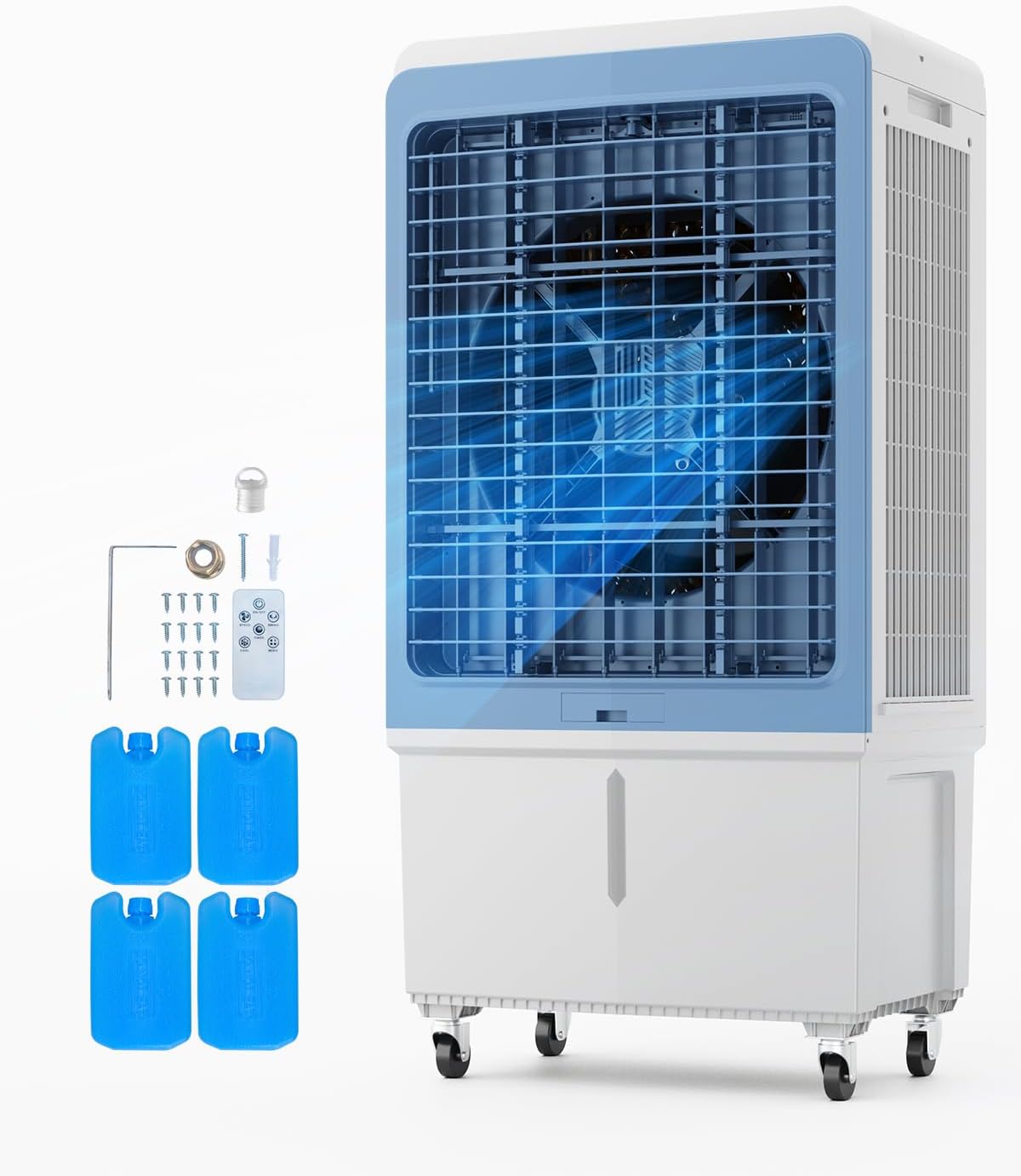
Some coolers come with ice packs that make the air leaving the unit feel colder. The TABU cooler comes with four ice packs, the Uthfy cooler comes with three ice boxes, and the SereneLife cooler comes with two ice packs. The SereneLife cooler also runs as a fan or a humidifier, and the TABU cooler runs as a fan on its own. Use the mode that fits the room: fan-only when you want moving air without added moisture.
Controls, timers and remotes
The TABU cooler has a 24-hour timer, an LED display and a remote control. The SereneLife cooler has a 12-hour timer, a remote control and Wi-Fi control through a mobile app. The Uthfy cooler uses a mechanical control panel with buttons for fan speed, cooling mode and oscillation. Set the timer when you want the cooler to switch off on its own, and keep the remote close to your seat.
What you need
As an Amazon Associate I earn from qualifying purchases. Product details come from each Amazon listing; we do not test products in person.
-

TABU Portable Tower Fan
Its 47-inch tower pairs evaporative cooling with a fan mode, four ice packs, three speeds, a 24-hour timer and a remote control.
View on Amazon -

Uthfy 41" Swamp Cooler
It moves 4,800 CFM with a 10.6-gallon tank, three ice boxes, three speeds and 120-degree oscillation for large indoor and outdoor spaces.
View on Amazon -

SereneLife Portable Swamp Cooler Air Conditioner
It moves 2,500 CFM with an 8-gallon tank, two ice packs, a 12-hour timer, a remote control and Wi-Fi control through a mobile app.
View on Amazon
These come from our ranked list Best Home Swamp Cooler, which compares them spec by spec.
FAQ
Do evaporative air coolers need a window open?
They need fresh air moving through the room, so leave a window or door open a little while the cooler runs. A closed room lets the moist air build up, and the cooling effect drops as the air gets damper.
What is the difference between an evaporative cooler and an air conditioner?
An evaporative cooler cools air as water on its pads turns to vapor, with no compressor and no refrigerant, and it adds moisture to the air. An air conditioner uses a compressor and refrigerant to remove heat and moisture from the air, and it needs a window vent or an outside unit.
Can I use an evaporative cooler in a humid room?
It will add more moisture to air that is already damp, so the cooling effect is weaker there. These coolers suit dry rooms and dry climates, where the air can take in the water the pads give off.
Do I need to add ice to an evaporative cooler?
No. The cooler works on water alone, and the ice packs that come with some models only make the air feel colder. Freeze the packs the maker supplies and use them when you want that extra chill.