
How-to · Dehumidifiers
Desiccant vs Compressor Dehumidifier
 By Laura Benning · Updated · How we pick
A compressor dehumidifier cools air so moisture condenses into a tank, while a desiccant dehumidifier absorbs moisture into a drying material and heats it to release the water. Compressor units suit warm rooms and large spaces, and desiccant units keep working in cold rooms where coils would frost. Compare pints per day, coverage, tank size and drainage before you choose.
How a compressor dehumidifier works
A compressor dehumidifier cools air so moisture condenses on cold coils and drips into a tank or out through a drain hose. The Waykar removes 34 pints per day and is rated for up to 2,000 sq ft, the KNKA removes 34 pints per day and is rated for up to 2,500 sq ft, the Midea removes 20 pints per day, 30 pints (2012 DOE), and is rated for up to 1,500 sq ft, and the DREO removes 75 pints per day and is rated for up to 4,500 sq ft.
How a desiccant dehumidifier works
A desiccant dehumidifier pulls moisture into a drying material instead of cooling the air, then heats the material to release the water into a tank. With no cold coils to frost, it keeps working in cold rooms where a compressor unit would need defrost cycles. It adds warmth to the room as it runs, so check the room and the maker's manual before you choose it for a warm room.
Compare pints, coverage and tank size
Pints per day is the moisture a unit removes in a day, so compare figures measured the same way. The Midea lists 20 pints per day, 30 pints (2012 DOE), while the Waykar and KNKA list 34 pints per day and the DREO lists 75 pints per day. Coverage is the maker's own figure: 1,500 sq ft for the Midea, 2,000 sq ft for the Waykar, 2,500 sq ft for the KNKA and 4,500 sq ft for the DREO. Tank size decides how often you empty it: 0.66 gallons for the Waykar, 12 liters for the Midea, 1.85 gallons for the DREO and 0.79 gallons for the KNKA.
Check controls, noise and drainage
The DREO lists 41 dB and the KNKA lists 37 dB. All four have a washable filter, and each has a drain hose, so you can drain continuously instead of emptying the tank. The Waykar and Midea have 2 fan speeds, the DREO has 3 fan speeds and the KNKA has 2 fan speeds. Check the controls and the tank size for the room before you buy.
What you need
As an Amazon Associate I earn from qualifying purchases. Product details come from each Amazon listing; we do not test products in person.
-
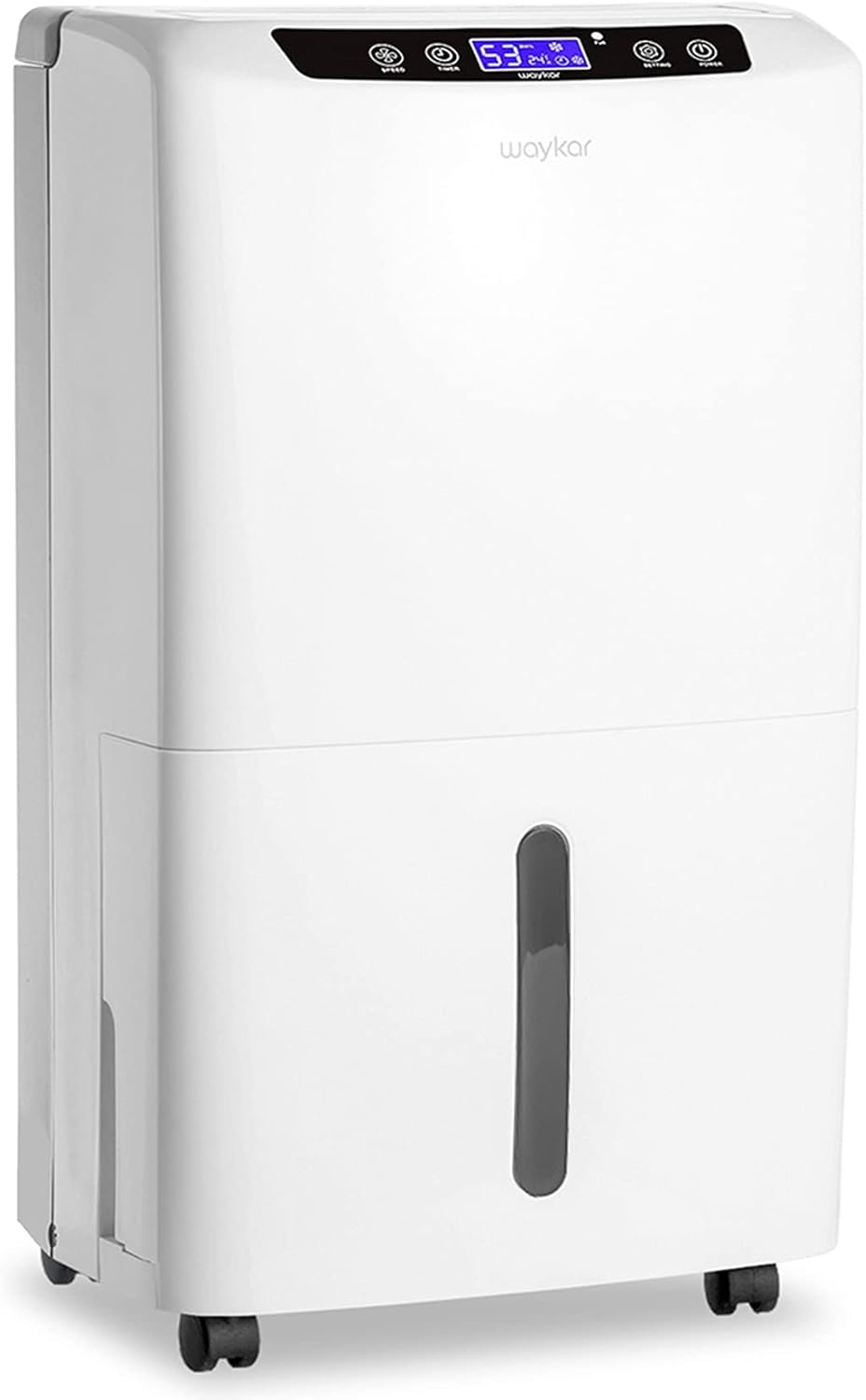
Waykar 34 Pints 2000 Sq. Ft.
A compressor dehumidifier that removes 34 pints per day, rated for up to 2,000 sq ft, with a 0.66-gallon tank and a drain hose.
View on Amazon -

Midea Cube 20 Pint Dehumidifier for Basement
A 20-pint dehumidifier, 30 pints (2012 DOE), rated for up to 1,500 sq ft, with a 12-liter tank, a drain hose and Wi-Fi app control.
View on Amazon -

DREO Energy Star 2025 Smart Dehumidifier
A 75-pint dehumidifier rated for up to 4,500 sq ft, with a 1.85-gallon tank, a drain hose, app control and a 41 dB noise rating.
View on Amazon -

KNKA 2500 Ft² Max 34 Pints Dehumidifier
A compressor dehumidifier that removes 34 pints per day, rated for up to 2,500 sq ft, with a 0.79-gallon tank and a 37 dB noise rating.
View on Amazon
These come from our ranked list Best Dehumidifier, which compares them spec by spec.
FAQ
Desiccant or compressor: which should I choose?
It depends on the room. A compressor unit suits a warm room, and a desiccant unit keeps working in a cold room where coils would frost. Compare pints per day and coverage for the room before you choose.
What do pints per day mean?
Pints per day is the moisture a unit removes in a day. The Midea lists 20 pints per day, 30 pints (2012 DOE), the Waykar and KNKA list 34 pints per day, and the DREO lists 75 pints per day.
Do these dehumidifiers need a drain hose?
No. Each has a tank you can empty, and all four include a drain hose for continuous drainage. The Waykar tank holds 0.66 gallons, the Midea 12 liters, the DREO 1.85 gallons and the KNKA 0.79 gallons.


