How-to · Reverse Osmosis Systems
How a Reverse Osmosis Membrane Works
 By Laura Benning · Updated · How we pick
A reverse osmosis membrane is a thin sheet that lets water molecules pass and holds back dissolved solids and larger particles. Tap water is pushed against the membrane under pressure, and the water that passes through goes to the faucet while the rejected water runs to the drain. Filters ahead of the membrane catch larger particles and chlorine, and a filter after it improves the taste.
Pressure pushes water through the membrane
Water from the tap enters the system and is pushed against the membrane by the pressure in the line. The membrane is a thin sheet with pores so small that water molecules pass through while dissolved solids and larger particles are held back. The water that passes through is the filtered water, and it flows on to the faucet or to a storage tank. The water left behind carries the rejected material away.
What the membrane holds back
The membrane stops dissolved solids and particles that are too large to pass through its pores. The iSpring system reduces TDS, PFAS, chlorine, lead and fluoride, and the Electrolux system reduces PFAS, fluoride, heavy metals, nitrates, chlorides and large particles. The exact list differs from one system to the next, so read the specification of the system you own. The membrane itself adds nothing to the water; it only separates what passes from what stays behind.
Where the rejected water goes
Not all the water that enters the system passes through the membrane. The water that stays behind carries the rejected material to the drain, so the membrane does not clog with what it holds back. The Electrolux system has a 3:1 pure-to-drain ratio, and the Waterdrop system has a 2:1 pure-to-drain ratio. A higher pure-to-drain ratio means less water goes to the drain for each cup of filtered water.
Flushing and filter changes keep the membrane working
Over time, material held back by the membrane can build up on its surface. The Electrolux system can rinse the membrane through the app, which helps reduce impurity buildup and clogging. Filters wear out with use, so replace them on the schedule in the maker's manual. The APEC system recommends replacing filters every 6 to 24 months, based on incoming water quality.
Stages before and after the membrane
A reverse osmosis system has more than the membrane. Stages before it catch larger particles and chlorine, and stages after it improve taste or add minerals back. The Electrolux system uses a single all-in-one filter with 12 stages, the Waterdrop system has 8 stages, the iSpring system has 6 stages and the APEC system has 5 stages. The iSpring and Waterdrop systems add minerals back after the membrane.
What you need
As an Amazon Associate I earn from qualifying purchases. Product details come from each Amazon listing; we do not test products in person.
-

Electrolux PureOne 1200GPD Tankless Reverse Osmosis Under
Its single all-in-one filter has 12 stages, and the app can flush the membrane to reduce buildup, with a 3:1 pure-to-drain ratio.
View on Amazon -
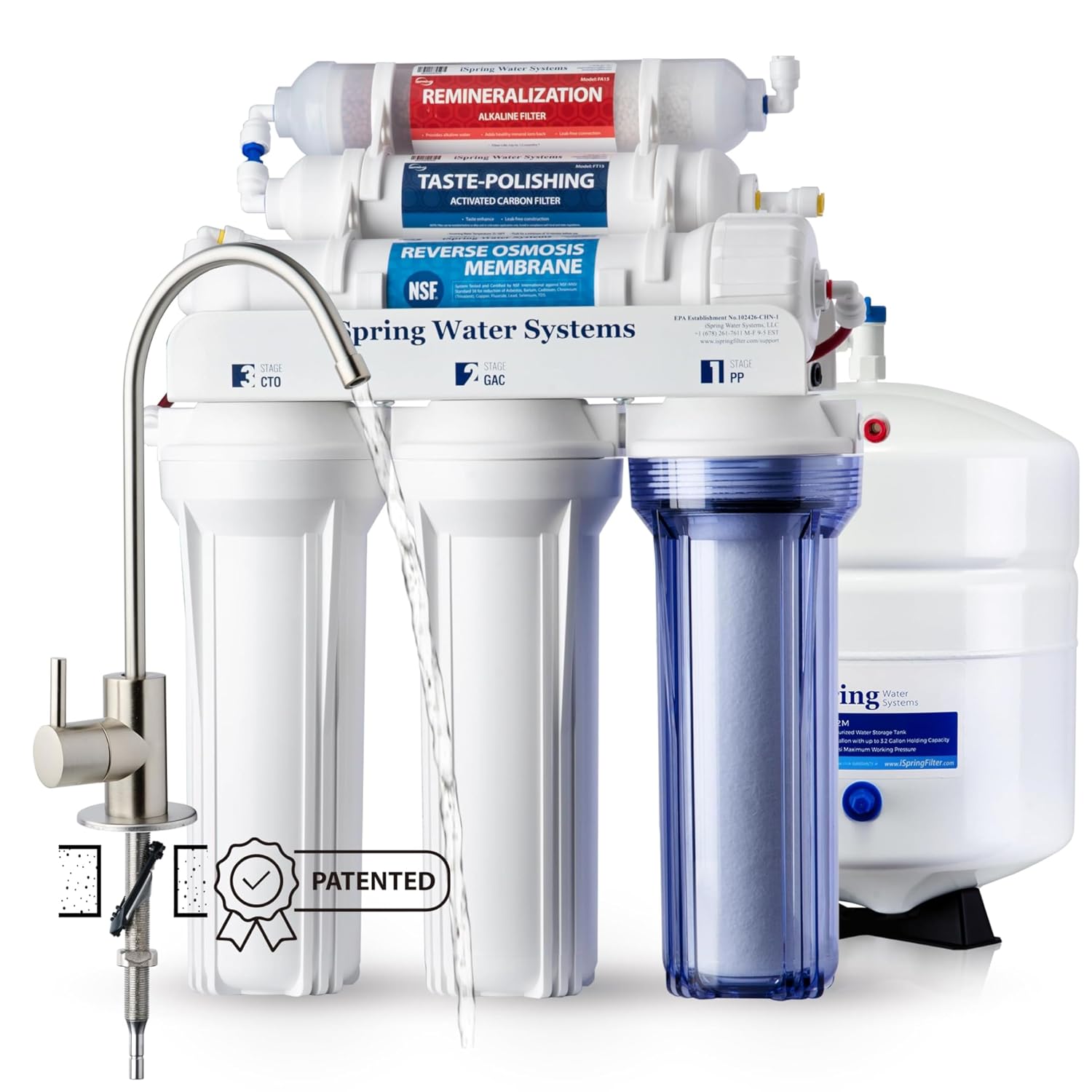
iSpring RCC7AK-BN NSF Certified
Its 6-stage system is certified to NSF/ANSI 58, and its mineral stage adds minerals back after the membrane.
View on Amazon -

Waterdrop G5P500A Reverse Osmosis System
Its 0.0001 μm membrane reduces particles larger than 0.0001 μm, with 8 stages and a 2:1 pure-to-drain ratio.
View on Amazon -

APEC Water ROES-50
Its 5-stage system is certified to NSF/ANSI 58 and 372, and its filters last 6 to 24 months between changes.
View on Amazon
These come from our ranked list Best Reverse Osmosis, which compares them spec by spec.
FAQ
What does a reverse osmosis membrane remove?
It holds back dissolved solids and particles too large to pass through its pores. The iSpring system reduces TDS, PFAS, chlorine, lead and fluoride, and the Waterdrop system reduces PFOA, PFOS, chlorine, lead, fluoride and heavy metals.
Why does some water go to the drain?
The water that does not pass through the membrane carries the rejected material away, so the membrane stays clear. The Electrolux system has a 3:1 pure-to-drain ratio, and the Waterdrop system has a 2:1 pure-to-drain ratio.
How often do I change the filters?
Follow the schedule in the maker's manual for your system. The APEC system recommends replacing filters every 6 to 24 months, based on incoming water quality, and the Electrolux filter lasts up to 2 years.