
How-to · Reverse Osmosis Systems
Reverse Osmosis vs Carbon Filter
 By Laura Benning · Updated · How we pick
A reverse osmosis system pushes water through a membrane that reduces dissolved solids such as TDS, PFAS and fluoride, while a carbon filter works on chlorine and taste through carbon stages. The RO systems here use a membrane, and the iSpring and the APEC pair it with carbon stages. Choose RO when you want the membrane's reductions, and carbon alone when chlorine is the only concern.
What the membrane does
The RO membrane is the stage that sets these systems apart from a carbon-only filter. The iSpring lists TDS reduction of 93 to 98 percent and PFAS reduction of 96 to 99 percent, and the Electrolux lists reductions of PFAS, fluoride, nitrates and chlorides. The Waterdrop pairs a 0.0001 micrometer RO membrane with an alkaline mineral stage, and the APEC lists removal of up to 99.99 percent of impurities.
What the carbon stages do
Carbon shows up as a stage inside some of these RO systems. The iSpring lists activated carbon among its purification methods and states chlorine reduction of 95 to 99 percent, and the APEC lists activated carbon alongside reverse osmosis. Carbon stages take on chlorine, which is the part of filtration that shapes taste and odor. That is why some RO systems still include carbon even though the membrane does the finer work.
Read the output and drain figures
Output is rated in gallons per day: the Electrolux lists 1,200 GPD, the Waterdrop 500 GPD, the iSpring 75 GPD and the APEC 50 GPD. RO systems also list a pure-to-drain ratio: the Electrolux lists 3:1 and the Waterdrop 2:1, so part of the water goes to drain. The Electrolux and the Waterdrop are tankless, while the iSpring and the APEC include a storage tank. Match the output to how much filtered water your household uses in a day.
Check certifications and filter life
Certification numbers tell you which standard the system meets: the iSpring is certified to NSF/ANSI 58, and the Waterdrop and the APEC are certified to NSF/ANSI 58 and 372. Filter life also varies: the Electrolux all-in-one filter lasts up to 2 years, the iSpring offers replacement sets for 6 months, 1 year, 2 years and 3 years, and the APEC suggests replacing filters every 6 to 24 months based on incoming water quality. Follow the schedule in the maker's manual.
Which one fits your water
Start from what you want reduced. For dissolved solids such as TDS, look at the maker's stated reductions and the maximum TDS level the system supports: the iSpring lists 750 ppm, the Waterdrop 500 ppm and the APEC 2,000 ppm. For chlorine alone, a carbon stage may be enough, and the iSpring and APEC pair carbon with a membrane. For a small household, a lower GPD system may be enough; for a busy household, the higher GPD systems give more water per day.
What you need
As an Amazon Associate I earn from qualifying purchases. Product details come from each Amazon listing; we do not test products in person.
-

Electrolux PureOne 1200GPD Tankless Reverse Osmosis Under
A 12-stage tankless system at 1,200 GPD with a 3:1 pure-to-drain ratio, WiFi app monitoring and a filter that lasts up to 2 years.
View on Amazon -
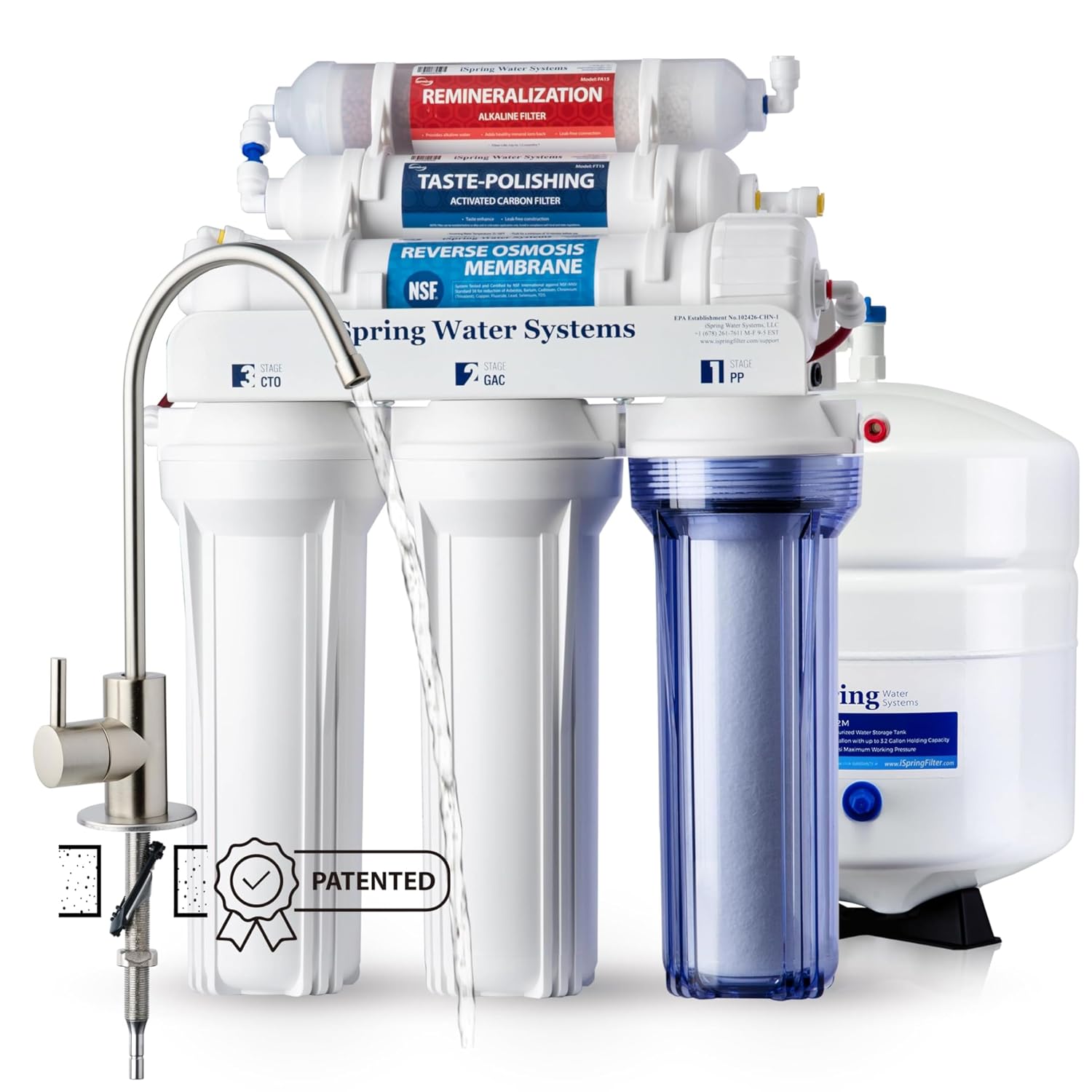
iSpring RCC7AK-BN NSF Certified
A 6-stage system at 75 GPD with remineralization, NSF/ANSI 58 certification and a transparent first-stage housing.
View on Amazon -

Waterdrop G5P500A Reverse Osmosis System
An 8-stage tankless system at 500 GPD with a 2:1 pure-to-drain ratio, remineralization and NSF/ANSI 58 and 372 certification.
View on Amazon -

APEC Water ROES-50
A 5-stage system at 50 GPD with NSF/ANSI 58 and 372 certification, a storage tank and quick-connection fittings for DIY setup.
View on Amazon
These come from our ranked list Best Reverse Osmosis, which compares them spec by spec.
FAQ
Does reverse osmosis remove chlorine?
Yes, through its carbon stages. The iSpring states chlorine reduction of 95 to 99 percent, and its purification methods list activated carbon.
Do reverse osmosis systems waste water?
They send part of the water to drain. The Electrolux lists a 3:1 pure-to-drain ratio and the Waterdrop lists 2:1, so 1 cup of wastewater goes with every 3 cups of purified water on the Electrolux, and 1 cup with every 2 cups on the Waterdrop.
Does reverse osmosis water need minerals added back?
Some systems add them back. The iSpring has a mineral stage that adds minerals to the water, and the Waterdrop pairs its membrane with alkaline mineralization. Check the maker's stated stages when you compare systems.
Do these systems need power or a tank?
It depends on the system. The Electrolux and the Waterdrop are corded electric and tankless, while the iSpring needs no power and includes a storage tank. The APEC includes a tank as well.


