
How-to · Reverse Osmosis Systems
Reverse Osmosis System Explained
 By Laura Benning · Updated · How we pick
A reverse osmosis system pushes tap water through a fine membrane that holds back dissolved minerals and other particles, so filtered water reaches the faucet and the rest goes to the drain. The membrane works with pre-filters and, on some models, a remineralization stage that adds minerals back. Choose by stage count, output in gallons per day, tankless or tank design, and the pure to drain ratio.
How reverse osmosis works
Tap water first passes through pre-filters that catch larger particles, then pressure pushes it through the reverse osmosis membrane. The membrane holds back dissolved minerals and other particles while filtered water passes through to the faucet. The water that does not pass through the membrane goes to the drain as wastewater. Follow the maker's installation manual, and hire a licensed plumber where the manual says so.
Stages in the four systems here
Stage count differs across the four systems here. The Electrolux PureOne uses 12 stages in a single all-in-one filter, the Waterdrop G5P500A uses 8 stages, the iSpring RCC7AK-BN uses 6 stages, and the APEC ROES-50 uses 5 stages. More stages do not by themselves mean a better fit for a household, so compare the stage list for each model with what the household wants the system to do.
Tankless or tank design
A tankless system sends filtered water straight to the faucet, while a tank system stores filtered water in a tank for use at the faucet. The Electrolux PureOne and the Waterdrop G5P500A are tankless. The APEC ROES-50 and the iSpring RCC7AK-BN include a storage tank. A tankless design leaves more room under the sink, while a tank holds filtered water ready for the faucet.
Pure to drain ratio
The pure to drain ratio says how much filtered water the system makes for each part that goes to the drain. The Electrolux PureOne lists a 3:1 pure to drain ratio, and the Waterdrop G5P500A lists a 2:1 pure to drain ratio. A higher first figure in the ratio means more filtered water for each part sent to the drain. Check the ratio in the listing for the model you choose.
Match output to the household
Output is listed in gallons per day, and the four systems here differ widely on that figure. The Electrolux PureOne lists 1200 GPD, the Waterdrop G5P500A lists 500 GPD, the iSpring RCC7AK-BN lists 75 GPD, and the APEC ROES-50 lists 50 GPD. Compare those figures with how much filtered water the household uses for drinking and cooking each day, and follow the maker's manual for setup and care.
What you need
As an Amazon Associate I earn from qualifying purchases. Product details come from each Amazon listing; we do not test products in person.
-

Electrolux PureOne 1200GPD Tankless Reverse Osmosis Under
A tankless 1200 GPD system with 12-stage filtration, a single all-in-one filter, a 3:1 pure to drain ratio and WiFi control through an app.
View on Amazon -
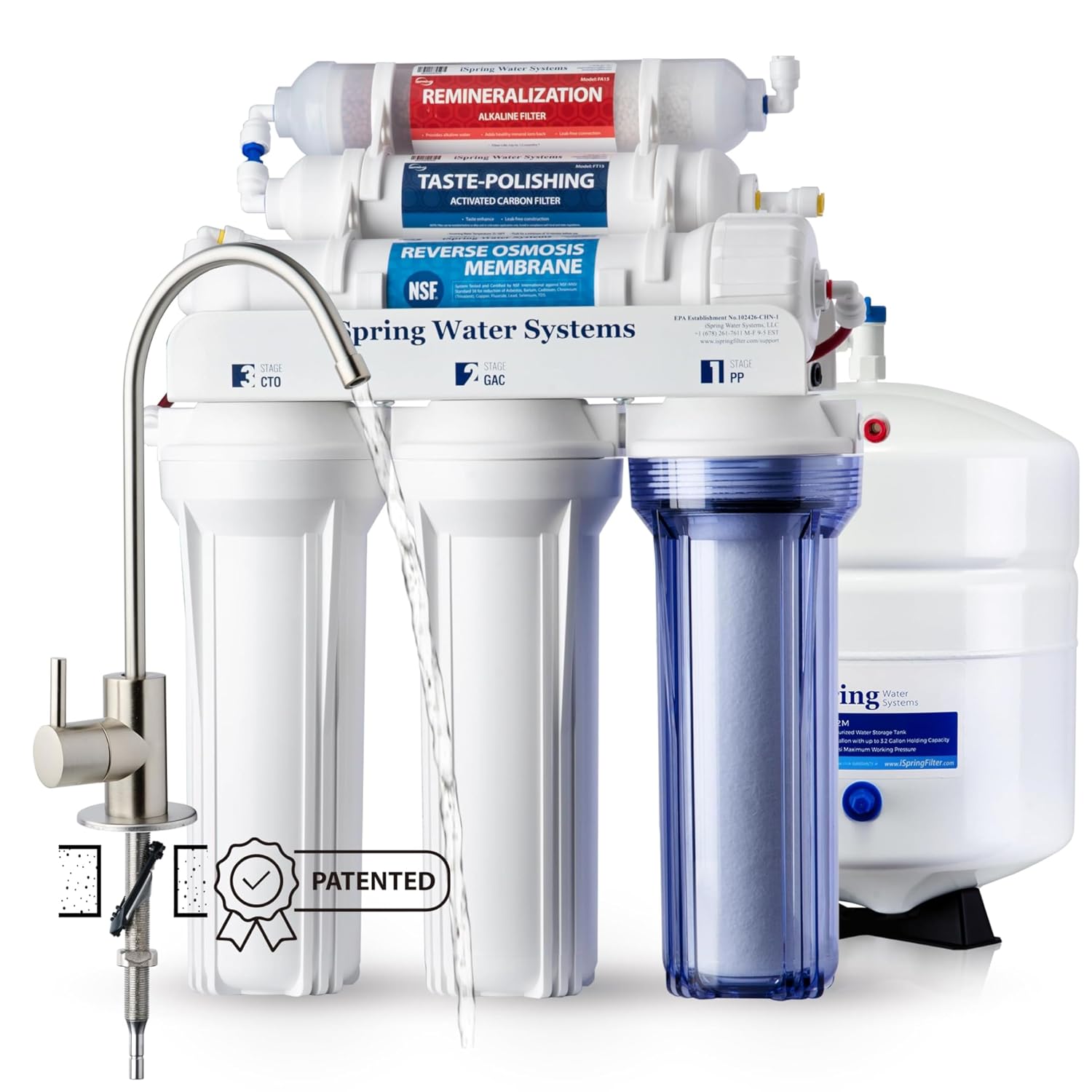
iSpring RCC7AK-BN NSF Certified
A 75 GPD 6-stage system with alkaline remineralization, NSF/ANSI 58 certification and a transparent first-stage filter housing.
View on Amazon -

Waterdrop G5P500A Reverse Osmosis System
A tankless 500 GPD 8-stage system with alkaline mineral pH+, NSF/ANSI 58 and 372 certification and a 2:1 pure to drain ratio.
View on Amazon -

APEC Water ROES-50
A 50 GPD 5-stage system with NSF/ANSI 58 and 372 certification, a storage tank and a brushed nickel faucet.
View on Amazon
These come from our ranked list Best Reverse Osmosis, which compares them spec by spec.
FAQ
How often do the filters need replacing?
Follow the schedule in the maker's manual. The Electrolux single all-in-one filter lasts up to 2 years, while the APEC filters are replaced every 6 to 24 months based on incoming water quality.
Does reverse osmosis remove minerals from water?
The membrane holds back dissolved minerals, so the filtered water carries fewer of them. The iSpring RCC7AK-BN and the Waterdrop G5P500A add minerals back through a remineralization stage.
Do I need a system with a tank?
A tank is not required. The Electrolux PureOne and the Waterdrop G5P500A are tankless, while the APEC ROES-50 and the iSpring RCC7AK-BN include a storage tank for filtered water.


