
How-to · Reverse Osmosis Systems
Reverse Osmosis Filters You Need
 By Laura Benning · Updated · How we pick
A reverse osmosis system stacks several filters in a row, and the four systems here run from 5 to 12 stages. Two of them add an alkaline remineralization stage, and daily output runs from 50 to 1200 gallons per day. Match the stage list and the output to your household, then follow the maker's manual for fitting and filter changes.
The stages in a reverse osmosis system
Each system lists its stage count: the APEC has 5 stages, the iSpring has 6, the Waterdrop has 8 and the Electrolux has 12. The iSpring and the Waterdrop add an alkaline remineralization stage. Read the maker's stage list for the system in hand, since a higher stage count on its own says nothing about which filters it holds.
Match daily output to your household
Daily output is the gallons-per-day figure: the APEC gives 50, the iSpring gives 75, the Waterdrop gives 500 and the Electrolux gives 1200. The Electrolux fills a 6-ounce cup in about 3 seconds at 0.85 gallons per minute, and the Waterdrop fills a 6-ounce cup in 8 seconds. The Electrolux lists a 3:1 pure-to-drain ratio and the Waterdrop a 2:1 ratio. Compare the output and the ratio with how much filtered water your household draws in a day.
Tank or tankless under the sink
The Electrolux and the Waterdrop are tankless, so no tank sits under the sink. The Electrolux measures 17.1 by 7.1 by 10.3 inches. The iSpring and the APEC include a storage tank in the box. The Waterdrop connects to ice makers and fridges through its Waterdrop XT link, and the iSpring faucet mounts from above the countertop. Measure the space under your sink and compare it with the figures the maker lists.
When to change each filter
Follow the schedule in the maker's manual. The Electrolux uses one all-in-one cartridge that lasts up to 2 years, and its smart faucet and app show filter status. The iSpring lists replacement sets for 6 months, 1 year, 2 years and 3 years, and its transparent first-stage housing shows buildup. The APEC says to replace filters every 6 to 24 months, based on incoming water quality. Watch for a filter that looks grey or an app alert, and change the cartridge on the maker's schedule.
What you need
As an Amazon Associate I earn from qualifying purchases. Product details come from each Amazon listing; we do not test products in person.
-

Electrolux PureOne 1200GPD Tankless Reverse Osmosis Under
Its single all-in-one cartridge gives 12-stage filtration at 1200 GPD, with a smart faucet and app that show filter status.
View on Amazon -
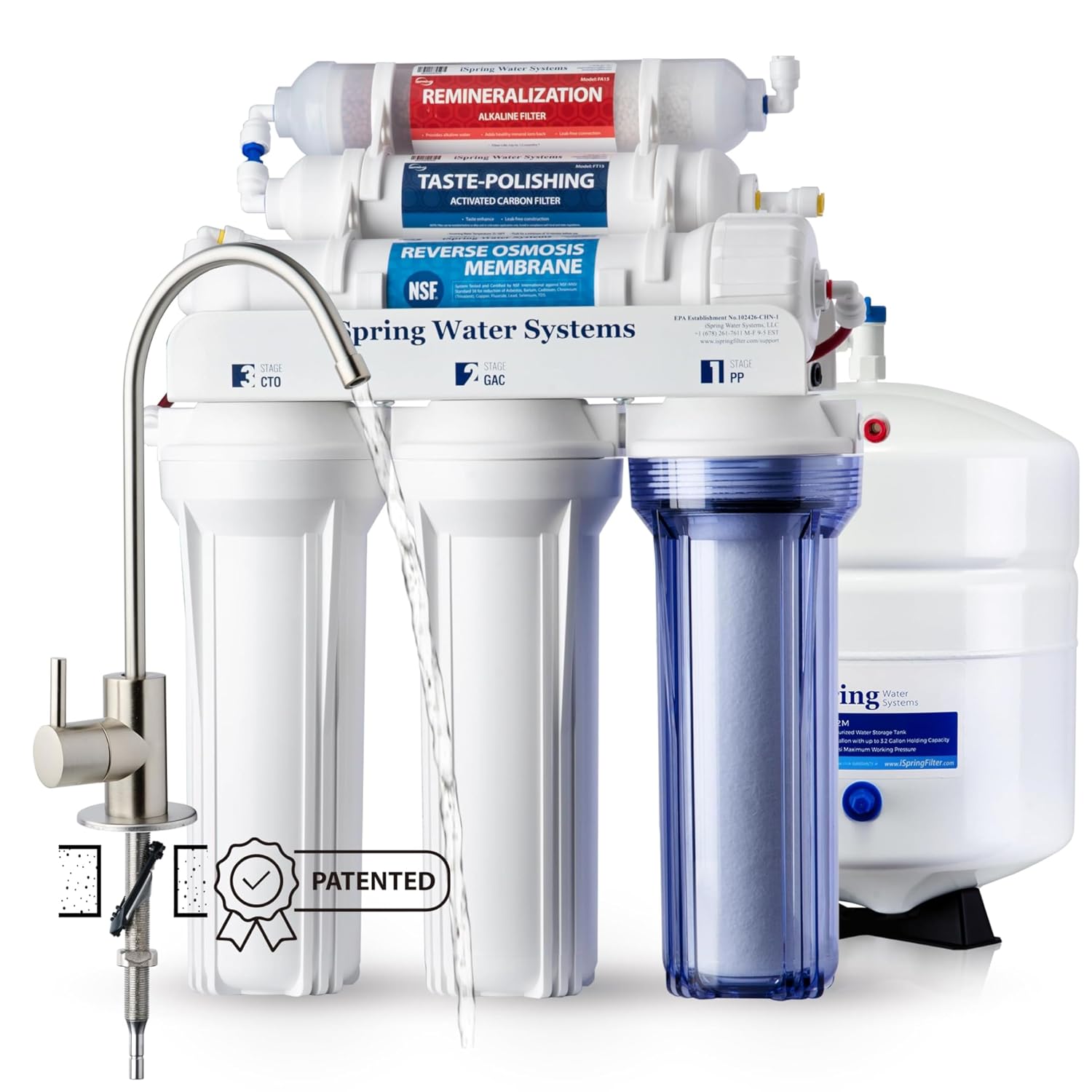
iSpring RCC7AK-BN NSF Certified
Its 6-stage system adds an alkaline mineral stage, is certified to NSF/ANSI 58, and uses a transparent first-stage housing.
View on Amazon -

Waterdrop G5P500A Reverse Osmosis System
Its 8-stage tankless system gives 500 GPD with a 2:1 pure-to-drain ratio and is certified to NSF/ANSI 58 and 372.
View on Amazon -

APEC Water ROES-50
Its 5-stage system gives 50 GPD, is certified to NSF/ANSI 58 and 372, and includes a tank, faucet and filter set.
View on Amazon
These come from our ranked list Best Reverse Osmosis, which compares them spec by spec.
FAQ
How many filter stages does a reverse osmosis system need?
The four systems here have 5, 6, 8 and 12 stages. Read the maker's stage list: a higher count on its own says nothing about which filters the system holds, so check what each stage does before you choose.
What is the difference between a tank and a tankless system?
A tankless system holds no tank under the sink: the Electrolux and the Waterdrop are tankless. The iSpring and the APEC include a storage tank that holds filtered water ready to draw.
Do I need a remineralization stage?
Two of the four systems include one: the iSpring and the Waterdrop add alkaline minerals to the filtered water.


