How-to · Mesh Wi-Fi Systems
Powerline Adapter vs Mesh Wi-Fi: How They Differ
 By Laura Benning · Updated · How we pick
A powerline adapter carries the network over the wiring between two adapters plugged into outlets, while mesh Wi-Fi spreads the network through units that share a single network name. Powerline fits a room with a wired device, and mesh fits coverage across rooms and floors, from the eero Pro 7 at 6,000 sq ft to the Orbi 870 at 9,000 sq ft as rated by the maker.
How a powerline adapter works
A powerline adapter kit starts with one adapter plugged into a wall outlet near the router and joined to it by an Ethernet cable. The other adapter plugs into an outlet in the room that needs a connection, and it gives that room a wired Ethernet port. The signal travels over the electrical wiring already in the walls, so no new cable runs through the house. The link depends on the wiring between the two outlets, so placement and the state of the wiring shape what you get.
How mesh Wi-Fi works
A mesh system uses several units that work together as one network. The main unit plugs into the modem, and the other units sit in rooms around the home, passing the signal between them. Your phone or laptop stays on the same network name as you move from room to room, and the system hands the device to the nearest unit. The four systems here come as 3-packs, and the Orbi 870 adds a satellite for up to 3,000 sq ft of additional coverage, while Tenda lets you add a node to an existing Nova network.
Coverage and device counts
Coverage is the maker's rated figure, so compare it the same way across models. The Orbi 870 is rated for up to 9,000 sq ft, the Deco 7 Pro for up to 8,100 sq ft, the Tenda Nova MX12 for up to 7,000 sq ft, and the eero Pro 7 for up to 6,000 sq ft. Device counts differ too: the eero Pro 7 supports 600+ devices, the Deco 7 Pro over 200 devices, the Tenda Nova MX12 over 160 devices, and the Orbi 870 up to 150 devices. Match the rated coverage to the size of your home and the device count to the gadgets on your network.
Wired ports and backhaul
Wired ports matter when a device needs a cable. Each Deco 7 Pro unit has 10 Gbps, 2.5 Gbps and 1 Gbps WAN/LAN ports, plus a 10 Gbps wired backhaul between units. The Orbi 870 has a 10 Gig internet port plus 2.5 Gig LAN ports across the router and satellites. The eero Pro 7 has two auto-sensing 5 GbE ports and supports internet plans up to 5 Gbps. The Tenda Nova MX12 is a dual-band Wi-Fi 6 system with speeds up to 2976 Mbps.
Which one fits your home
The adapter pair gives that room a cable connection without running a new cable. Choose mesh when the Wi-Fi itself needs to reach more rooms and floors, since extra units extend the same network instead of adding a separate network. Set up the mesh units through the app named by the maker: Deco, Orbi and Tenda each name an app for setup and management.
What you need
As an Amazon Associate I earn from qualifying purchases. Product details come from each Amazon listing; we do not test products in person.
-

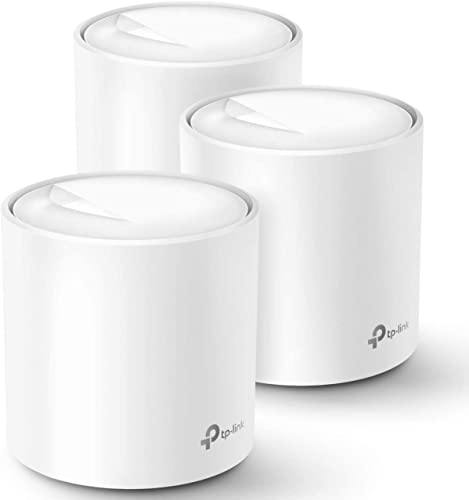
TP-Link Deco 7 Pro Tri-Band BE14000 Wi-Fi
A 3-pack Wi-Fi 7 mesh system rated for up to 8,100 sq ft and over 200 devices, with 10 Gbps ports and AI-Roaming under one network name.
View on Amazon -

NETGEAR Orbi 870 Series WiFi 7 Mesh
A Wi-Fi 7 mesh system, 3-pack, router plus two satellites, rated for up to 9,000 sq ft and 150 devices, with a 10 Gig internet port.
View on Amazon -

Amazon eero Pro 7 tri-band mesh Wi-Fi
A 3-pack Wi-Fi 7 mesh system rated for up to 6,000 sq ft and 600+ devices, with two 5 GbE ports and support for plans up to 5 Gbps.
View on Amazon -

Tenda AX3000 WiFi 6 Mesh System Nova
A 3-pack Wi-Fi 6 mesh system rated for up to 7,000 sq ft and over 160 devices, with speeds up to 2976 Mbps and app setup.
View on Amazon
These come from our ranked list Best Mesh WiFi System, which compares them spec by spec.
FAQ
Do I need a modem with mesh Wi-Fi?
Yes, the mesh unit connects to a modem. Deco notes that a modem must be purchased separately, and Orbi connects to your existing modem for cable or fiber service.
Can I add more units to a mesh system?
Yes, on the models that name it. Orbi lets you add an Orbi 870 satellite for up to 3,000 sq ft of additional coverage, and Tenda lets you add a node to an existing Nova network with the push of the Mesh button.
Does mesh Wi-Fi use one network name?
Deco creates a unified home network under a single network name, so devices move between units without a new name. Tenda lets you set different SSIDs for the 2.4G and 5G bands instead.